New paints for overhead conductors: higher emissivity, lower temperature and greater ampacity with De Angeli Prodotti technical coatings.
The energy transition is requiring power grids to transport more energy, more efficiently, and with an increasingly lower environmental impact. In this scenario, innovation lies not only in new conductive materials or digital monitoring systems, but also in an often overlooked element: the conductor’s surface area. De Angeli Prodotti, in collaboration with its supplier, is testing new technical coatings for overhead conductors with the aim of increasing emissivity, reducing operating temperature, and improving current carrying capacity, also known as ampacity.
Indice:
- 1. Surface treatments: when the surface becomes part of the performance
- 2. Emissivity, reflectance and SRI: the three key variables
- 3. Technical comparison between the tested paints
- 4. A new balance between landscape, performance and electricity grid
- 5. Product focus: high-efficiency coated conductors
- 6. Conclusion
1. Surface treatments: when the surface becomes part of the performance
For overhead power line conductors, the outer surface serves more than just aesthetic or protective purposes. It can influence thermal behavior, visual impact, ice formation, corona noise, and, in general, the infrastructure’s acceptability in the local area.
For years, De Angeli Prodotti has been working on surface treatments to meet different needs:
- hydrophilic surfaces and sandblasted conductors to reduce corona effect
- super-hydrophobic coatings to mitigate ice formation in anti-ice conductors
- colored conductors to reduce the visual impact of power lines.
A dedicated in-depth analysis is available in the article Surface treatments on conductors, which explains how modifying the surface can affect the emission and absorption coefficients compared to an untreated conductor.
The new study on technical paints fits precisely into this trajectory: it’s not just about coloring the conductor, but about designing a surface capable of interacting more efficiently with solar radiation and heat exchange with the environment.
2. Emissivity, reflectance and SRI: the three key variables
To understand the technical value of these coatings it is useful to start with three physical quantities.
- Solar reflectance indicates how much solar radiation is reflected by the surface. A high reflectance reduces the absorption of solar energy and therefore limits heating of the conductor. For example, a reflectance of 100% indicates a completely reflective surface.
- Thermal emissivity, on the other hand, measures the surface’s ability to emit heat in the form of infrared radiation. A surface with high emissivity is better able to dissipate heat to the outside environment. For example, an emissivity of 100% indicates a surface that emits all the absorbed heat in the form of radiation.
- The Solar Reflectance Index (SRI) combines these two aspects and provides a summary indication of a surface’s tendency to heat up under solar radiation. Higher values indicate a surface that, all other things being equal, tends to reach lower temperatures.
The ongoing study compares different coating formulations, including black paint and light gray paint. The data shows a very significant difference between dark and light colors: black paint offers excellent camouflage properties in natural settings, such as wooded areas or sensitive landscapes, but absorbs a very high proportion of solar radiation. Light gray paint, on the other hand, thanks to its greater reflectivity, allows for significantly lower surface temperatures.
3. Technical comparison between the tested paints
To objectively evaluate the performance of the different coatings, the main thermal-radiative parameters of the tested paints were compared: solar reflectance, emissivity, SRI in low wind conditions, and estimated surface temperature. The table highlights how, given the same coating quality, the chemical nature of the paint plays a decisive role in the thermal balance of the conductor: dark finishes favor visual integration, while lighter finishes offer superior performance in terms of temperature reduction.
| Sample | Solar reflectance | Emissivity | SRI (Low wind) | Surface temperature (Low wind) |
|---|---|---|---|---|
| Black paint | 6.1% | 88.8% | 0.3 | 103.6 °C |
| Light gray paint | 47.1% | 86.7% | 50.7 | 76.1 °C |
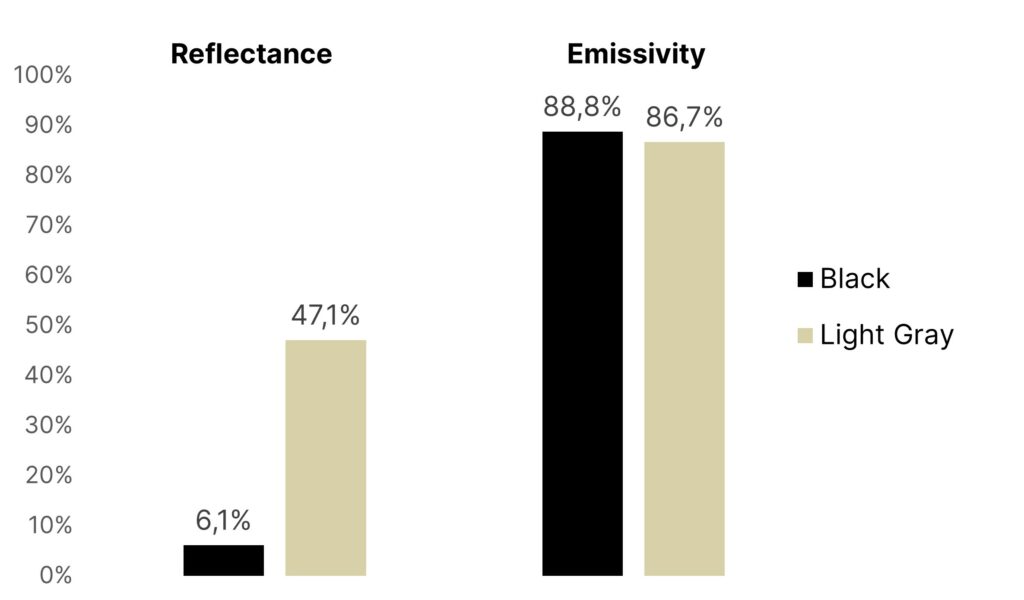
The most obvious result concerns the difference between the black and light gray paints. Both paints have high emissivity, 88.8% and 86.7%, respectively. However, the solar reflectance changes dramatically: 6.1% for black, 47.1% for light gray. This translates into a surface temperature, under low wind conditions, of 103.6°C for black and 76.1°C for light gray. The difference is 27.5°C.
As shown in the graph below, the chosen coatings allow for greater reflectivity even in wavelengths related to the IR spectrum. This would not occur without appropriate modifications to the paint chemistry.
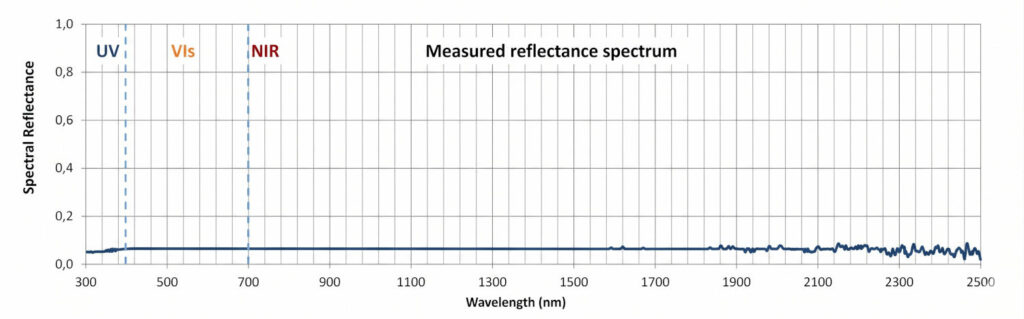
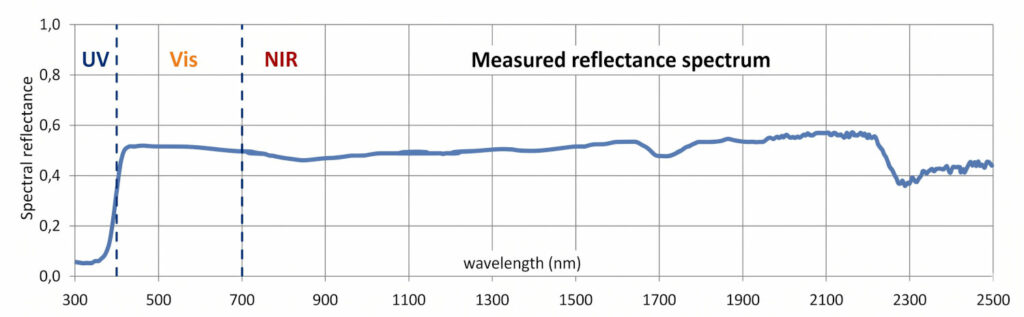
Note: The performance limit of black does not depend on the quality of the paint, but on the physics of color. A black surface absorbs much more solar radiation. Consequently, even with high emissivity, it tends to reach higher temperatures than a light surface. As already said, this difference can be modulated or mitigated by researching the chemical composition of the paints used.
3.1 Black paint: camouflage and reduction of visual impact
Black paint retains an important technical role when the primary goal is to reduce the visual impact of the conductor. In wooded, mountainous, or landscape-sensitive areas, a dark, matte finish can make the line less noticeable against the natural backdrop.
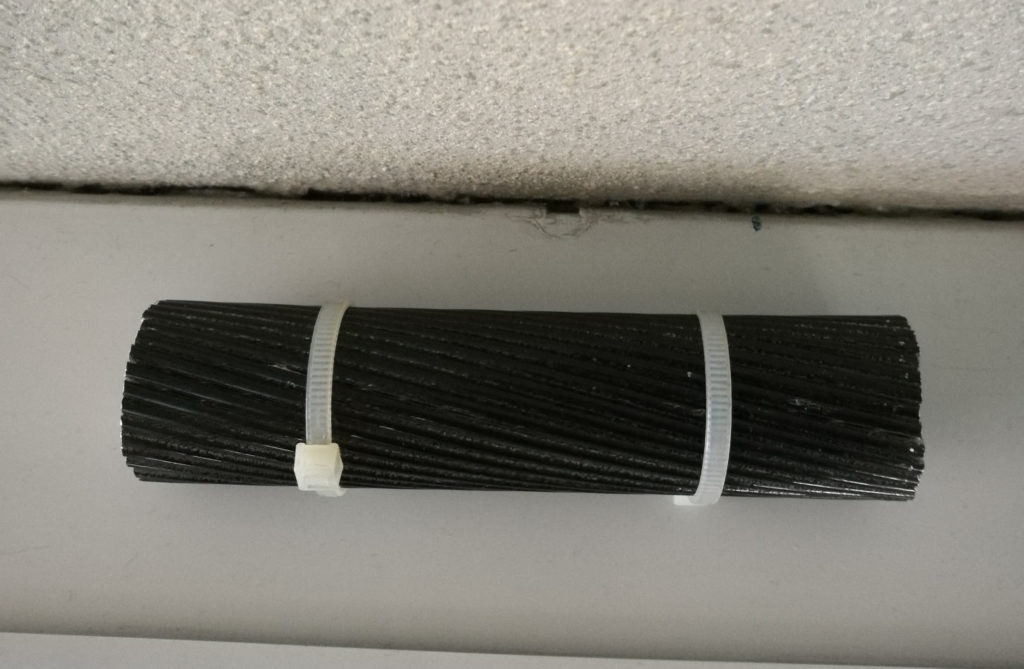
This feature is consistent with De Angeli Prodotti’s experience with colored conductors, developed specifically to mitigate the reflective effect of overhead conductors and improve their integration into the landscape by reducing the visual impact of power lines.
From a thermal perspective, however, black has an intrinsic limitation: its low solar reflectance, equal to 6.1%, results in a strong absorption of radiation. For this reason, in the simulations and tests reported, the surface temperature exceeds 100°C in low wind conditions.
3.2 Light gray paint: thermal efficiency and increased ampacity
Light gray paint, on the other hand, represents the most attractive solution when improving the conductor’s thermal performance is the priority.
Its performance is the result of a combination of two factors: a much higher solar reflectance than dark finishes and an equally high emissivity. In other words, this new technical coating absorbs less solar energy and continues to effectively dissipate the heat generated by the passage of current.
This has a direct impact on ampacity. Under the same environmental conditions and thermal limit of the conductor, a surface coated with this paint can carry higher currents while maintaining the same operating temperature. Alternatively, for the same current carried, it can help reduce the operating temperature, with potential benefits in terms of resistive losses, material lifespan, and line operating margin.
In the technical proposal contained in the study, the high-efficiency coating is presented as a passive cooling solution based on optimizing solar reflectance and thermal emissivity, with expected benefits in terms of increased ampacity, reduced operating temperature, improved transmission efficiency, and lower environmental impact.
3.3 Application analysis table
| Project objective | More coherent solution | Technical motivation |
|---|---|---|
| Reducing visual impact in wooded areas | Black paint | Dark and opaque color, greater camouflage effect |
| Reduction in surface temperature Potential increase in ampacity | Light gray paint | High reflectance and high emissivity Lower temperatures under the same operating conditions |
3.4 Thermal tests and behavior over time
In addition to evaluating reflectance and emissivity parameters, the study also includes a phase to verify the coating’s stability over time. Specifically, accelerated aging tests are underway on painted plates, with the aim of observing the behavior of the light gray paint under severe thermal conditions and evaluating its long-term evolution.
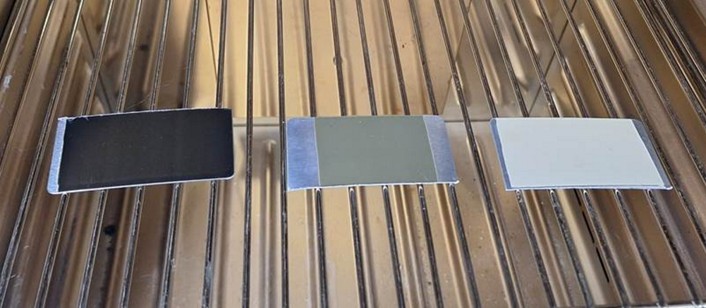
This work will allow us to explore not only the coating’s initial performance but also its long-term reliability, a crucial aspect for overhead conductor applications. Reducing the surface temperature must be accompanied by adequate coating stability, depending on the expected operating conditions of the line.
4. A new balance between landscape, performance and electricity grid
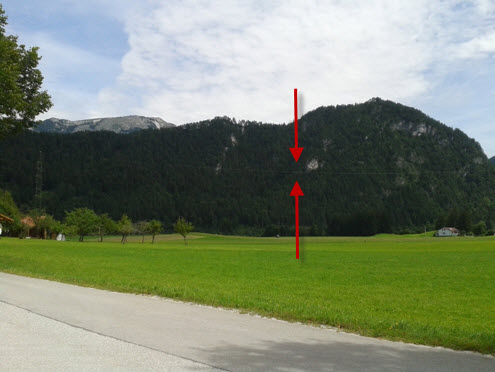
The value of these studies lies not in the search for an absolute “best paint“, but in the ability to choose the surface treatment best suited to the required function.
When the priority is landscape integration, a black finish may be preferable. When the goal is to increase the line’s transmission capacity or reduce operating temperature, a lighter formulation like gray offers much more obvious advantages.
This approach is particularly important in a context where electricity grids must manage increasing loads, the integration of renewables, new connections, and greater operational variability. Every degree less in conductor temperature can translate into technical margins, efficiency, and resilience.
5. Product focus: high-efficiency coated conductors
De Angeli Prodotti is expanding its experience in surface treatments with new coating solutions designed for the passive cooling of overhead conductors.
The goal is to develop coatings capable of combining:
- high thermal emissivity;
- increased solar reflectivity;
- stability over time;
- compatibility with different operating temperatures;
- ability to adapt the color to the required function.
In particular, light gray emerges as a highly promising formulation for applications where thermal efficiency and increased ampacity are priorities. Black, on the other hand, remains a particularly attractive solution when the primary driver is to blend the conductor into the landscape.
6. Conclusion
Surface treatments are becoming an increasingly strategic lever for the evolution of overhead power lines. They not only alter the conductor’s appearance, but can also help improve its thermal behavior, environmental acceptability, and ability to meet evolving grid requirements.
The study on black and light gray technical paints confirms a key principle: the color and chemical composition of the paint are not limited to aesthetic details, but rather to various engineering variables. Dark finishes offer clear advantages in terms of reduced visual impact; light finishes, on the other hand, significantly reduce surface temperatures and open up new possibilities in terms of ampacity.
For De Angeli Prodotti, this research represents a further step towards increasingly efficient, resilient, and integrated conduits.