HTLS conductors with a carbon core offer high performance, but how is their long-term reliability assessed? We examine accelerated aging methods and the importance of rigorous testing to verify the durability of the materials.
The global electricity transmission grid is undergoing an unprecedented transformation. Energy consumption is constantly rising, and the transport of energy is constrained by a rigid infrastructure, most high-voltage backbone lines were designed decades ago to handle stable power flows originating from a small number of large, fossil-fuel-powered plants.
Today, the massive influx of renewable energy sources, which are intermittent and distributed across the territory, is placing a severe strain on this legacy architecture, making the adoption of high-efficiency technologies an urgent necessity: traditional conductors (such as ACSR) are no longer sufficient to handle the substantial rise in electricity demand and the pronounced intermittency of renewable energy sources.
Composite-core conductors represent the most advanced technology available on the market when it comes to HTLS conductors.
Indeed, they combine the structural reliability provided by a carbon-fiber core, which offers excellent mechanical properties, with the ability to operate at high temperatures, thereby increasing energy transmission efficiency and reducing both losses and CO2 emissions.
Summary:
1. Carbon core conductors
Conductors that utilize a composite core are significantly lighter and possess greater mechanical strength compared to standard ACSR conductors. They can reduce losses by up to 10%, with a corresponding 100% increase in ampacity. Their lower weight allows for reduced sag and places less load on the supporting structures.
The adoption of conductors with a carbon core results in a more efficient and secure infrastructure, enabling an evolution of transmission networks that meets growing global energy demands.
1.1 Single core VS Multi wires core
There are primarily two types of conductors that use a carbon core:
- Single carbon core (ACCS – ACCS SENS)
- Multi carbon core (ACCM)
1.1.1 Single carbon core
The single-core ACCS solution is the most economical, but it certainly offers less flexibility and also requires greater care during the installation phase.
To address the growing demand from utilities to verify the integrity of this type of core, De Angeli Prodotti has developed a simple and reliable monitoring technology: ACCS–SENS, which utilizes three optical fibers embedded within the composite core. These fibers, combined with a dedicated interrogator unit, are used to monitor the structural integrity of the product, enhancing safety during installation and enabling the localization of any potential damage.
1.1.2 Multi wires carbon core
The ACCM (Aluminium Conductor Composite Multistrand) solution, by contrast, consists of multiple trapezoidally-shaped composite material strands stranded together. This structure offers significantly greater flexibility compared to ACCS conductors: any cracks that may develop over time do not propagate throughout the entire cross-section (as they would in an ACCS conductor) but remain confined to the individual strand, ensuring that the conductor retains its mechanical integrity.
For this reason, an ACCM core requires no monitoring whatsoever, as it possesses greater intrinsic safety; rather than consisting of a single wire of significant size, it is composed of multiple wires stranded around a central core wire. Furthermore, the segmental (keystone-shaped) design significantly increases the core’s compressive strength compared to a structure made entirely of round wires.
1.2 Two solutions with high corrosion protection
Despite their structural differences, both the ACCS and ACCM models supplied by De Angeli Prodotti offer a high level of protection against galvanic corrosion.
What is galvanic corrosion, and how does it occur?
Corrosion occurs when two conductive materials with different electrochemical potential come into direct contact in the presence of an electrolyte, such as water.
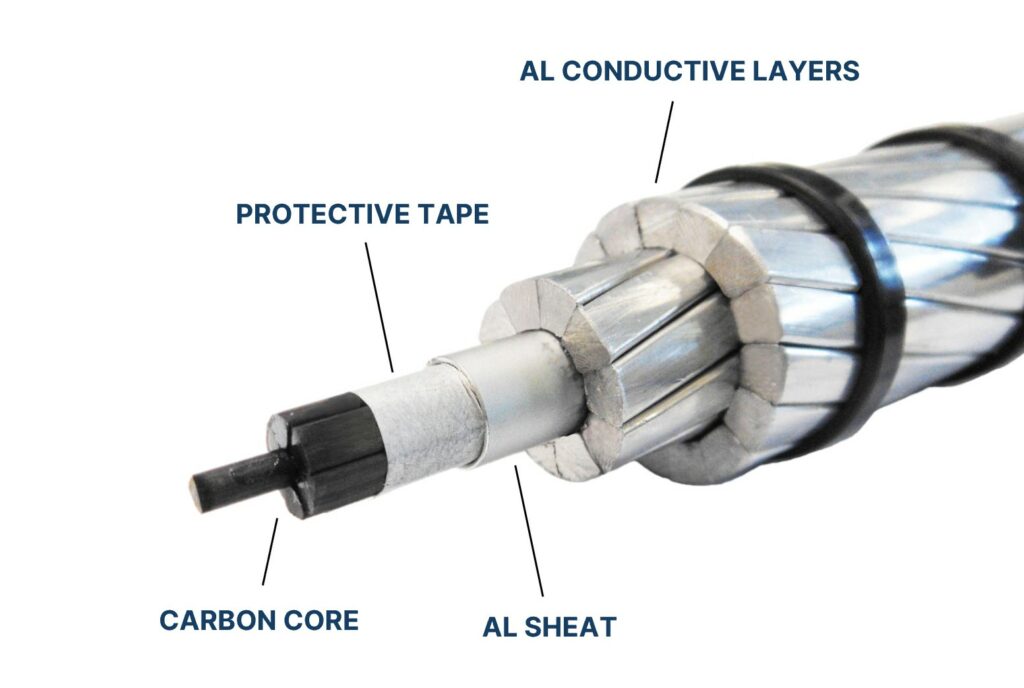
To prevent corrosion of the conductive layers, an aluminum tube is extruded over the core to block the ingress of water or vapor, the electrolyte that would otherwise trigger corrosion. Additionally, the carbon core is wrapped in a tape that serves as an extra physical barrier between the aluminum and the carbon.
In the absence of adequate protection, corrosion can lead to the degradation of aluminum and, in the worst cases, to structural failure of the lines.
2. Standardized accelerated aging tests
The properties of a carbon core must remain stable throughout the entire service life of a conductor; to verify this, aging tests are conducted to demonstrate the product’s viability for 40 to 50 years.
The following paragraph presents and compares, by way of example, a test standardized in accordance with IEC 62818 and an alternative, non-standardized test that is significantly less rigorous.
2.1 Aging of the carbon core according to the IEC 62818 standard
The IEC TS 62818-1 ED1 is an international technical specification published by the International Electrotechnical Commission (IEC) that defines systems and methods for the evaluation and use of fibre-reinforced composite cores as support elements in overhead line conductors.
It applies to composite cores with a polymer matrix used as the core in conductors for overhead lines, and provides guidelines for:
- Define common terms relating to fiber-reinforced, polymer-matrix composite cores.
- Specify methods for characterizing the properties of these cores.
- Recommend acceptance criteria, where applicable.
These tests and criteria ensure safe use and adequate quality under normal operating conditions.
A crucial aspect of this standard concerns the aging of the composite material that forms the core: throughout the conductor’s service life, the core’s polymer matrix is subject to thermo-oxidative processes, which can alter its properties. Since the composite core is designed to serve as the mechanical support for the overhead line, it must retain its characteristics throughout the entire service life of the line, typically 40 to 50 years.
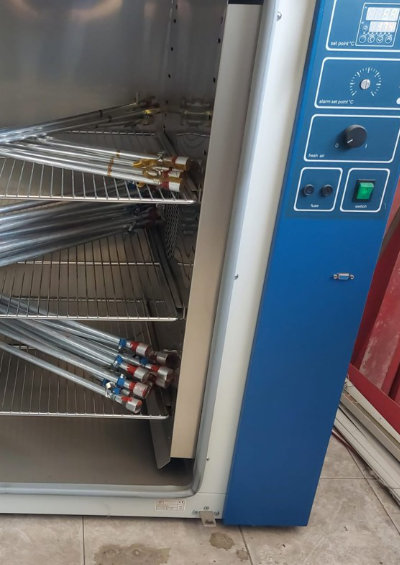
Since it is not possible to conduct a test of such duration, the only viable solution is to use accelerated aging procedures to demonstrate the durability of the core, at a specific temperature, over the required service period.
The procedure for the accelerated aging test is based on the Arrhenius curve method: various samples are aged over an extended period at different temperatures (for example, 180, 190, and 200°C) to trigger degradation reactions that damage the sample, resulting in a decline in its mechanical properties. Multiple tests are conducted at different temperatures because the kinetics of these degradation reactions are highly dependent on temperature.
Samples are periodically removed from the oven, and their mechanical properties are evaluated through a tensile-to-failure test; the load-bearing capacity decreases in proportion to both the temperature and the duration of exposure. The service temperature is estimated by constructing an Arrhenius plot, which is generated by plotting the test temperatures against the exposure times required to reach the end-of-test criterion.
There are two different methods that describe the test-termination criterion for each temperature tested. These are presented in the following section.
2.1.1 Two test methods: both valid but not equivalent
The test can be conducted according to two different end-of-test criteria specified in the standard:
- METHOD A: the test is considered complete when the experimental breaking load of the specimen reaches a value 5–10% lower than the NOMINAL breaking load
- METHOD B: the test is considered complete when the experimental breaking load of the specimen reaches a value 10% lower than the ACTUAL breaking load
In both cases, it is essential to reach the point at which a decline in the breaking load of the carbon composite is observed.
Although they may appear to be equivalent approaches, METHOD A is more flexible than METHOD B because it is based on the nominal load, a value declared by the manufacturer rather than one determined experimentally. This offers a significant advantage when adopting METHOD A: the nominal load is typically lower than the experimental breaking load. Consequently, if the declared nominal breaking load is low, the test-termination criterion becomes less restrictive, leading to higher projected service-life estimates (even though both methods begin from the same starting point: the actual breaking load).
METHOD B proves to be more reliable: the threshold at which the test is concluded is not defined by an arbitrary point based on manufacturer specifications, but rather by the experimental breaking load of the core prior to aging. In this way, the Arrhenius test yields results that are directly dependent on the material’s properties, rather than on a declared breaking load.
Below is a graph from an aging test conducted at 190°C.
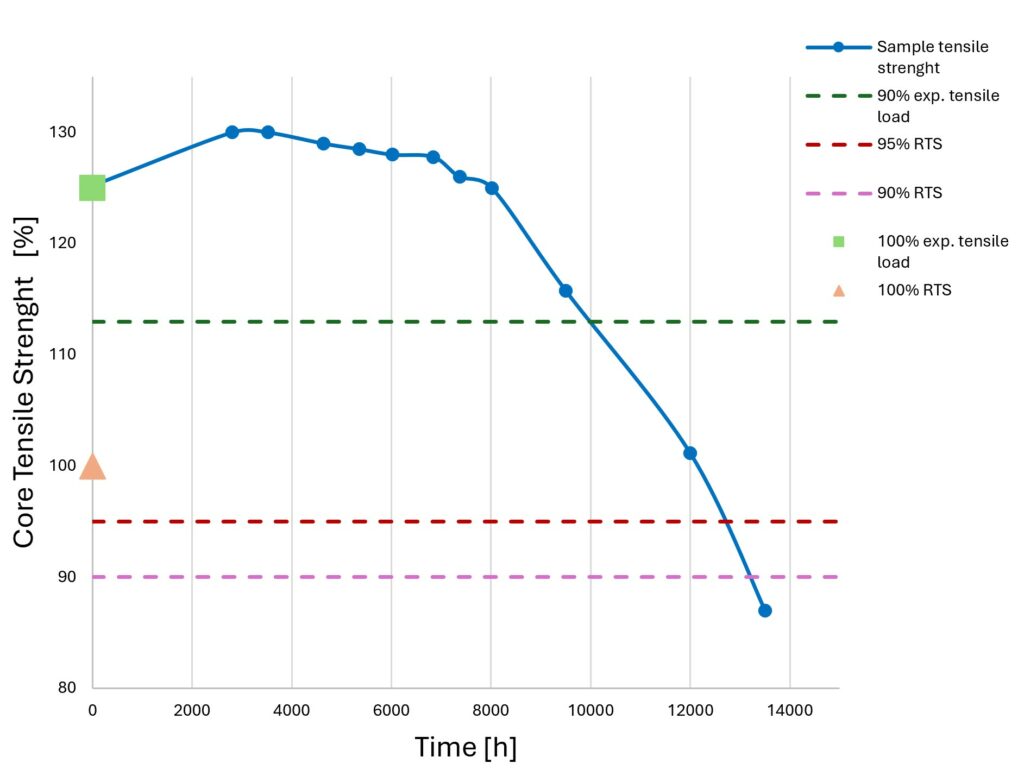
The initial increase in the breaking load of the samples, which can be observed in Figure 1, is likely caused by further curing of the polymer matrix, which enhances the mechanical properties of the product. Over time, this effect fades, and degradation reactions within the matrix begin to prevail.
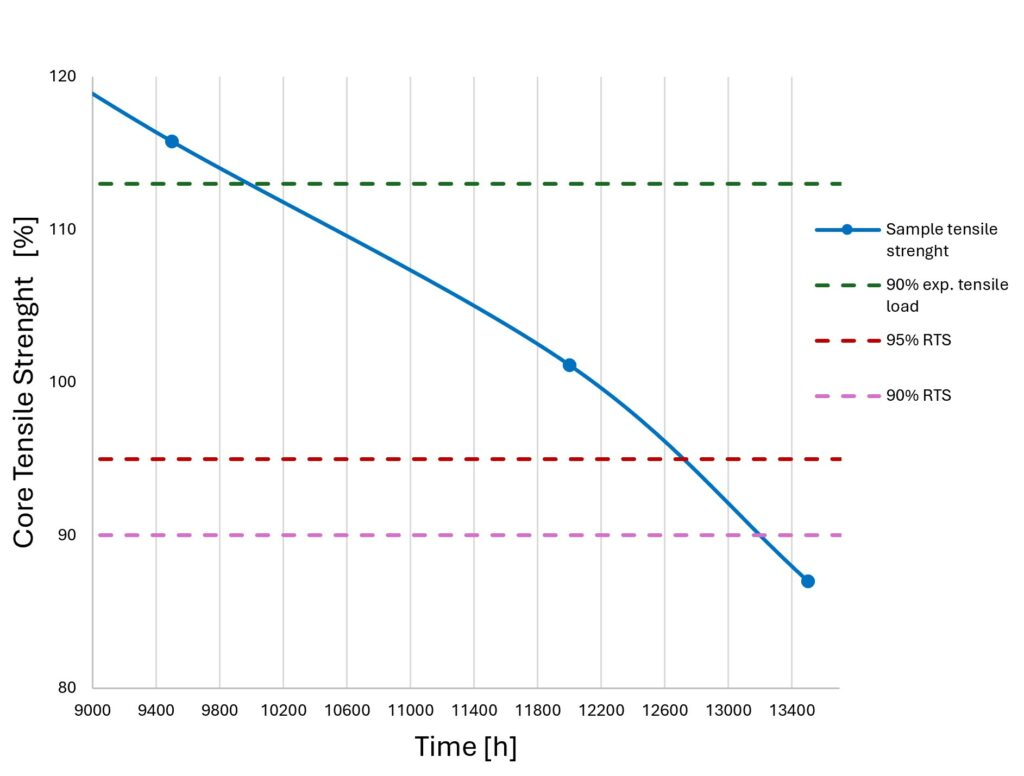
Figure 2 shows an enlargement of Figure 1 in the area where the ultimate load drops off.
Following METHOD B, a 10% decrease in RTSreal is reached after approximately 10,000 hours. With METHOD A, a 5% reduction in RTSnom is reached after 12,700 hours, and a 10% reduction in RTSnom is reached after 13,200 hours; thus, METHOD A offers an advantage over METHOD B of 2,700 hours in the first case and 3,200 hours in the second.
It is evident that METHOD A offers significant advantages during an Arrhenius aging test: such time savings at each tested temperature can lead to an increase in the final estimated lifespan of a carbon core.
The primary risk in using Method A without any discernment is the potential to overestimate the core material’s ability to withstand high temperatures: carbon fiber composites typically experience a collapse in mechanical properties at a certain stage during aging (as shown in Fig. 1, where a rapid decline in ultimate tensile strength occurs after 8,000 hours). Overestimating the product’s operating temperature by 5–10°C, a possible outcome when following Method A, reduces the safety margin by accelerating the degradation of the composite.
METHOD B therefore appears more robust and reliable, as there is no time gain and the operating temperature is not overestimated.
The analysis of the results just performed is applicable to any test temperature. De Angeli Prodotti follows the guidelines of METHOD B for testing every component of the HTLS conductors it markets.
2.2 Performance at high temperatures: declared or proven?
It is of fundamental importance to interpret data correctly, in accordance with relevant standards, to accurately estimate the operating temperature of a composite core. In some cases, aging tests may be based on non-standardized procedures for calculating the service temperature. Results obtained through such methods can create unrealistic expectations regarding product lifespan and may pose potential risks in applications where long-term reliability is critical.
An example is shown in Figure 3, where the data from the graph presented in the previous section are analyzed and interpolated using a different, non-standardized procedure that is not part of the guidelines set out in the IEC 62818 standard.
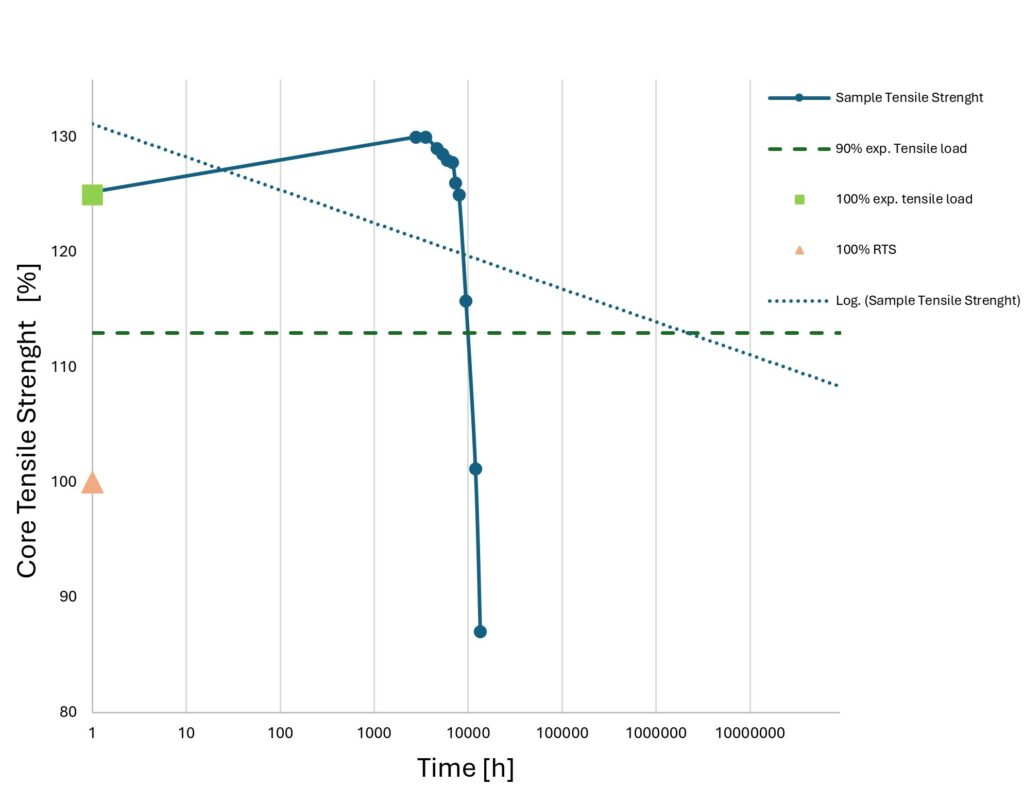
In this example, the samples are aged at a single temperature, then removed and tested to monitor the decline in their breaking load. The estimate of the conductor’s service life is not derived by interpolating data from multiple tests conducted at different temperatures; instead, it is extrapolated from a single test using a logarithmic law.
To compare this method with the standard method according to IEC 62818, the previous data are processed following this procedure. METHOD B is selected as the test termination criterion.
Following this methodology, the extrapolated service life is remarkably high and promising: the arrows in Figure 3 show that, at an operating temperature of 190°C, a composite core reaches an estimated service life of approximately 3 × 10⁶ hours, that is, 340 years! Although the ultimate load capacity drops very rapidly after 800 hours, this method allows for a service life estimate that exceeds even the most optimistic expectations.
Obviously, an estimate made in this way is unreliable compared to an Arrhenius test, for several reasons:
- Single temperature analyzed: the sample was tested at only one temperature, which does not allow for the precise determination of the activation energy required for a decay reaction to occur. Consequently, the test does not permit an Arrhenius-type validation, as multiple tests at different temperatures must be conducted to verify the kinetics of the degradation reactions.
- Logarithmic interpolation: unless supported by a physical and experimental rationale, a logarithmic model does not guarantee an accurate representation of long-term behavior. As seen in the graph in Figure 3, the load values remain nearly constant initially, only to collapse after 8,000 hours. A logarithmic interpolation fails to adequately describe such behavior, as it tends to flatten the estimated residual tensile strength (RTS) values of the core, leading to a significant overestimation of the sample’s service life. Furthermore, this type of curve fitting is highly sensitive to the data being interpolated. Removing or altering even a few data points results in vastly different service-life estimates, potentially by thousands of years! For instance, if only the final data point, the most critical one, which captures the rapid decline in breaking load, is excluded, the carbon core would appear to last forever (>10⁶ years!), showing no signs of degradation even after millennia.
- Interpolation type: if an Arrhenius aging procedure is to be followed, data interpolation is performed only after all tests at the various temperatures have been completed, not after a single test. The aforementioned fitting is not only incorrect but also serves no purpose in the context of an Arrhenius test.
In conclusion, this methodology does not allow for the assessment of long-term thermal resistance; it is not based on actual data, but rather on an extrapolation that yields unfounded values devoid of any physical meaning. In contrast to this method, the Arrhenius analysis provides a physically sound framework for evaluating aging behavior as a function of temperature.
At De Angeli Prodotti, we believe that specifications regarding operating temperatures should be based on sound scientific principles, recognized testing procedures, and transparent engineering assessments.
3. Conclusion
Carbon-core conductors represent a significant technological advancement for electrical transmission networks, combining high mechanical performance and low weight with the ability to operate at high temperatures. However, for infrastructure designed to remain in service for decades, initial performance is not enough: it is essential to understand how the materials will behave over time.
The durability of the composite core thus becomes an essential criterion in the evaluation of an HTLS conductor. As highlighted, different testing methodologies can lead to significantly different estimates of service life, even when based on the same experimental data. For this reason, adopting standardized procedures and rigorous evaluation criteria is indispensable for obtaining reliable results.
At De Angeli Prodotti, we have chosen to follow Method B as specified in IEC TS 62818-1, basing our aging assessments on the actual measured mechanical strength of the materials rather than on stated nominal values. This approach reflects our development philosophy: prioritizing the robustness of experimental evidence over the pursuit of exceptionally high theoretical performance.
With our ACCS, ACCS-SENS, and ACCM advanced conductors, we combine innovation in composite core design with a careful assessment of long-term reliability. This is because the quality of a conductor is measured not only by its current performance, but also by its ability to maintain its characteristics throughout the line’s operational lifespan.