Anti-Ice conductors are overhead lines with a super-hydrophobic coating that reduces water adhesion and ice formation, limiting overloads and failures.
Climate change has made extreme weather events more frequent and unpredictable and has led to the normalization of so-called “hybrid events” typical of temperate and mountainous zones (freezing rain, wet snow, rapid freeze/thaw cycles, etc.), which are dangerous because they amplify the risk of icing on overhead lines.
At the same time, the constant increase in electricity consumption in a phase still undergoing energy transition is pushing networks to operate with more dynamic loads and with a growing share of distributed renewable generation (wind and hydroelectric in often exposed areas, but also high-altitude connection backbones), making service continuity and infrastructural resilience enabling, not accessory, requirements.
In this complex and current scenario, it becomes necessary (especially in certain locations) to use Anti-Ice conductors. Thanks to their ability to reduce the likelihood and persistence of ice sleeves, they limit failures and the resulting power outages. This advantage is not just an end in itself: limiting emergency interventions in critical conditions while simultaneously ensuring greater reliability of strategic lines reduces operating costs, increasing both safety and service quality.
Summary:
- 1. Ice as a design constraint
- 2. What are Anti-Ice conductors?
- 3. De Angeli Prodotti’s contribution to the Anti-Ice sector
- 4. Operational evidence
- 5. I vantaggi dei conduttori Anti-Ice
- 6. Use cases where Anti-Ice makes the difference
- 7. Why choose De Angeli Prodotti as your partner
- 8. Conclusion: from weather event to resilient project
1. Ice as a design constraint
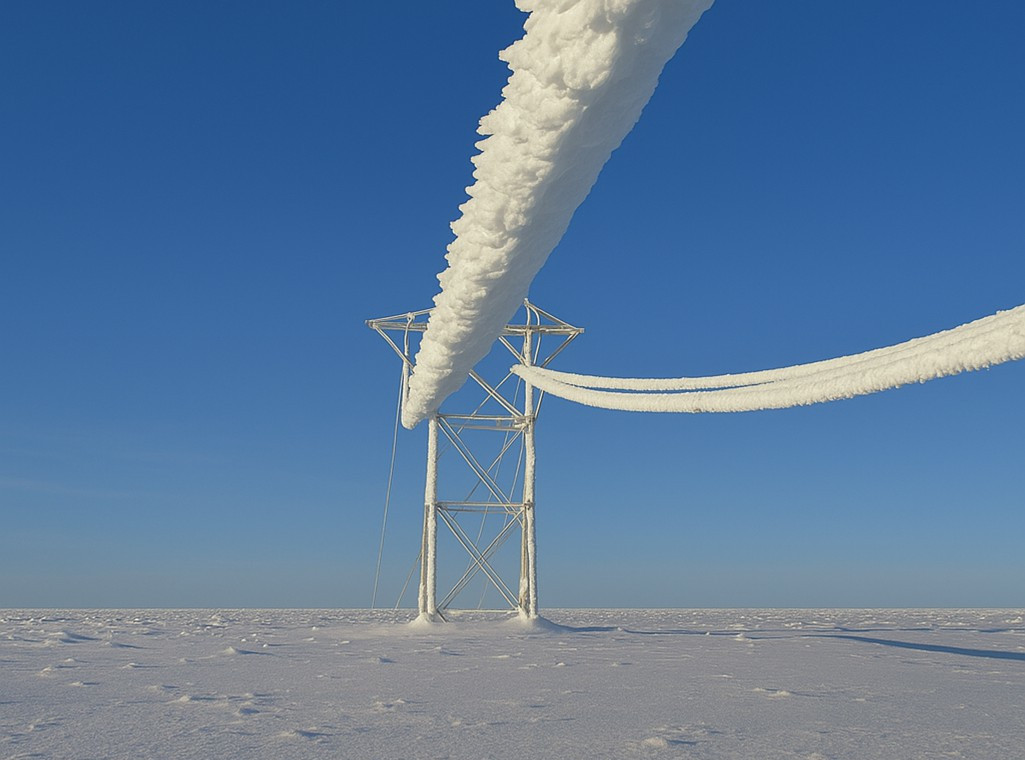
In the design and operation of overhead power lines, ice should not be treated as an episodic variable, but as a design constraint because it simultaneously alters the mechanical conditions and dynamic behavior of the system. The growth of ice sleeves increases the linear mass of the conductor, alters the aerodynamic cross-section of the span, and increases the loads on suspensions, insulators, and structural elements. This causes immediate damage to both the deflection and tension and, in the most severe cases, risks leading to failure. Precisely because of this “systemic” nature, icing requires informed decisions already in the engineering phase (from conductor selection to mitigation strategies). The goal is not only to withstand the event, but to reduce its probability, intensity, and duration, and to transform a difficult meteorological phenomenon into a manageable condition within the design.
2. What are Anti-Ice conductors?
Anti-Ice conductors are overhead line conductors featuring a surface treatment designed to prevent water from adhering and reduce the formation of ice on the metal surface. Their distinctive feature is a super-hydrophobic coating: essentially, a “slightly wettable” surface on which water droplets tend not to spread and adhere securely.
While traditional strategies often focus on mechanical oversizing, auxiliary devices, or the possibility of emergency intervention, Anti-Ice conductors offer a shift in perspective that focuses on prevention. Reducing the adhesion energy and the permanence of water/ice on the conductor limits the initiation of the ice sleeve and promotes detachment when environmental conditions permit.
To understand how this system works, we need to consider the concept of “wettability.” The formation of ice on an exposed object also depends on how water “interacts” with the surface: if it spreads to form an adherent film, the likelihood that, as the temperature drops, that film will freeze continuously and in a structured manner increases. Conversely, if the surface causes the water to remain in more mobile and less anchored droplets, growth tends to slow.

The superhydrophobic coating works precisely here: it modifies the behavior of water in contact with the metal, reducing the effective contact surface and the adhesion force. Functionally, this translates into two particularly interesting effects for a network operator:
- Delayed ice accumulation: decreases the likelihood of a continuous ice sleeve forming;
- Increased propensity for ice detachment: increases the likelihood of ice detaching more quickly as temperatures rise or when wind and natural vibrations of the span occur.
As anticipated in the previous paragraph, Anti-Ice conductors do not pretend to eliminate the difficulties deriving from meteorological events, but rather aim to significantly reduce their impact from an engineering point of view by reducing the energy and mass that actually end up weighing on the line.
3. De Angeli Prodotti’s contribution to the Anti-Ice sector
In the overhead line industry, the difference between a promising idea and a truly implementable technology is measured by three requirements: repeatability, compatibility, and quality control. An anti-ice treatment must be applicable on an industrial scale, with consistent performance from batch to batch, and without introducing critical issues in installation or management.
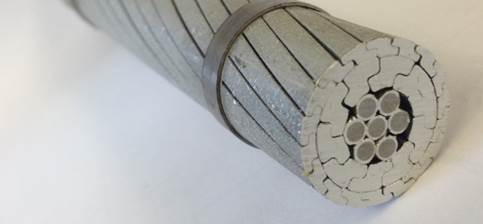
De Angeli Prodotti contributed to the engineering of this technology through experimentation, formulation development, line design, and production cycle stabilization. This resulted in a thin coating applied through a dedicated industrial process (UV polymerization/curing), designed to be efficient and compatible with conductor production.
From the customer’s point of view, this is a strategic point as they are not purchasing a “treatment” as an accessory, but a conductor that integrates the Anti-Ice function into a governed, traceable and replicable process.
4. Operational evidence
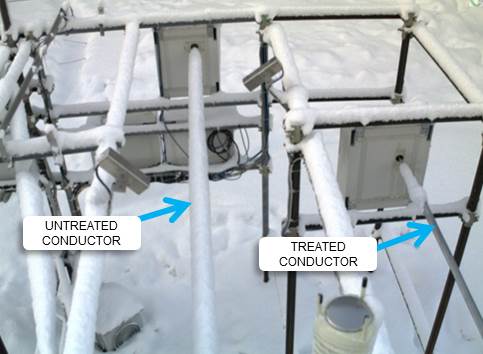
A professional audience cannot help but wonder about the measurability of the benefits of using Anti-Ice conductors in real-world settings. To this end, field tests were conducted in an Alpine environment with samples installed on devices that also simulate load-induced rotation. In these tests, the treated conductor demonstrated a working dynamic consistent with the expected function, resulting in less ice accumulation and faster ice removal compared to a standard conductor when conditions returned to their normal range (for example, above 0°C).
The value of these findings is not merely demonstrative: it is also design-related. In high-risk areas, what matters is reducing load peaks and the duration of the severe event. If a sleeve forms more slowly and is removed more quickly, the line’s exposure time to critical conditions is reduced, and with it, the likelihood of exceeding mechanical safety thresholds or triggering destructive dynamic phenomena.
5. The advantages of Anti-Ice conductors
After having anticipated some of the advantages of Anti-Ice conductors, we would like to examine in more detail how the main ones contribute to creating technical and economic assets:
- Containing overloads and protecting critical points. Reducing the additional mass caused by icing means reducing overall traction in the span and stress on suspensions, clamps, and track systems. In many lines, the vulnerable points are not only the conductors, but the entire conductor-accessory system: limiting the load, therefore, reduces the likelihood of collateral damage and accelerated degradation.
- Improving service continuity. Severe icing events are often associated with extensive failures and complex repairs, especially in difficult-to-access areas. Technology that reduces the severity of the event indirectly reduces unavailability and interruptions, with direct effects on service quality and indirect effects on reputational risk.
- Reducing operating costs and extraordinary interventions. Fewer emergencies mean fewer urgent inspections, fewer unplanned replacements, and fewer deployments in difficult weather conditions. Looking ahead, Anti-Ice can be seen as a tool for limiting OPEX and stabilizing maintenance.
- Greater infrastructure resilience in variable climate scenarios. Resilience is the ability to absorb an event and quickly return to normal conditions. A conductor that facilitates ice detachment helps reduce the line’s stress times, strengthening the robustness of the overall system.
- Application flexibility. The coating technology can be applied to different conductor families and, where necessary, also to guard wires. For the designer, this means being able to integrate the Anti-Ice function without disrupting established choices regarding cross-sections, materials, or line configurations, preserving already validated electrical and mechanical objectives.
6. Use cases where Anti-Ice makes the difference
The adoption of Anti-Ice conductors tends to be particularly effective in three contexts:
- mountain and pre-Alpine sections, with frequent freeze/thaw cycles;
- line corridors exposed to freezing fog or mixed precipitation, where ice growth can be rapid;
- strategic lines (essential links, critical load connections, difficult-to-repair backbones), where risk reduction is more important than the mere unit cost of the component.
7. Why choose De Angeli Prodotti as your partner
When a technology impacts the continuity of an essential service, choosing a supplier can’t be reduced to comparing cards: you need a partner capable of combining engineering expertise, industrial capacity, and application support. De Angeli Prodotti guarantees:
- Product expertise and process management: As a specialized conductor manufacturer, we can integrate the Anti-Ice treatment into the conductor production process, controlling process variables and ensuring consistent performance. This makes us more reliable and competitive than a company that starts with the next step, offering a coating treatment on the finished conductor.
- Applied research and a culture of experimentation: The Anti-Ice technology is the result of a research and development process that considered mechanical and dynamic aspects of the line, in addition to the coating chemistry. This approach is important because complex problems (such as icing) are rarely solved with a single parameter: they require systems thinking.
- Scalability and compatibility with customer projects: We understand that scalability is crucial for an EPC or operator: being able to replicate the solution on different sections, with different geometries and diameters, reduces engineering time, costs, and integration risks. The possibility of application on different types of conductors helps build progressive strategies: starting with the most exposed sections and then extending to the entire line, based on results and priorities.
- Technical support as a risk reduction factor: as an industrial partner with in-depth knowledge of the technology, we can guide clients to the best possible conditions and support them during the delicate project phase, when Anti-Ice requires in-depth technical dialogue (local risk analysis, definition of requirements, selection of the most suitable type of conductor, qualification criteria, and monitoring plans).
8. Conclusion: from weather event to resilient project
After seeing together how Anti-Ice conductors are the technologically targeted answer to a treacherous problem for overhead lines such as ice accumulation, we hope we have conveyed the message that the value of the solution lies not only in the physical principle (super-hydrophobicity), but in its transformation into a reliable and implementable industrial product.
In a context where the resilience of electrical infrastructure has become a strategic requirement, choosing a partner like De Angeli Prodotti means adopting a technology that combines applied research, process control, and design integration capabilities.