Life cycle, losses, and recycling of carbon-fiber-core conductors: the De Angeli Prodotti-Exel study presented at CIGRÉ 2026
What is the actual environmental impact of an electrical conductor? Answering this requires looking beyond the materials used to manufacture it; one must also consider what happens during the decades it spends transmitting energy, the electrical losses generated during operation, and the potential for material recovery at the end of its service life.
This is a particularly important perspective for advanced conductors with carbon-fiber cores, technologies that contribute to the modernization of electrical grids and the upgrading of existing infrastructure.
The study “Sustainable End-of-life for Advanced Composite Core Conductors“, developed by De Angeli Prodotti and Exel Composites and presented at the CIGRÉ Paris Session 2026, addresses precisely this issue through a life-cycle analysis of traditional and composite conductors.
Based on a reference service life of 40 years, the study examines the impact of production, electrical losses, and five possible end-of-life material management scenarios. The results demonstrate how a comprehensive environmental assessment can yield very different conclusions compared to a comparison limited solely to raw materials.
Summary:
- 1. Advanced conductors and the sustainability of electrical grids
- 2. Life Cycle Assessment (LCA) of conductors
- 3. Comparison of ACSR, ACCS, and ACCM conductors
- 4. Tecnologia ACCM e reconductoring
- 5. LCA results for composite conductors
- 6. End-of-life of carbon-fiber-core conductors
- 7. Collaboration between De Angeli Prodotti and Exel Composites
- 8. Conclusions
1. Advanced conductors and the sustainability of electrical grids
The energy transition does not depend solely on how much renewable energy we manage to produce. It will increasingly depend on the ability of electricity grids to transport it efficiently, reliably, and sustainably.
The electrification of consumption, the proliferation of intermittent renewable sources, the expansion of electric mobility, and rising demand are driving a profound transformation of transmission infrastructure. While building new lines remains necessary, it cannot be the sole solution; factors such as corridor availability, permitting processes, land-use impact, and implementation timelines make “reconductoring“, upgrading existing lines by replacing conductors while retaining existing infrastructure wherever possible, an increasingly strategic approach.
It is precisely in this context that advanced conductors with carbon-fiber cores play a significant role. Yet, when a technology emerges to contribute to the sustainable modernization of the grid, it must be subjected to an equally ambitious question: just how sustainable is it, really, when considering not only its production but its entire lifecycle?
The reference paper
Sustainable End-of-life for Advanced Composite Core Conductors it was presented at the CIGRÉ Paris Session 2026, nello Study Committee B2 – Overhead Lines. The work was born from the collaboration between tra Antti Hassinen and Heini Kloster from Exel Composites and Giorgia Dorigatti and Dilara Duman from De Angeli Prodotti.
View the summary and information regarding the official eCIGRE publication.
2. Life Cycle Assessment (LCA) of conductors
If we were to compare a traditional conductor with one featuring a composite core—considering solely the raw materials required for production—carbon fiber would start at a disadvantage. Indeed, the production of carbon fiber (CF) is an energy-intensive process and entails a higher specific impact than the steel used in traditional cores.
However, a conductor is not manufactured to remain stationary. It is installed on a power line and transmits energy for decades. Throughout this long period, factors such as electrical resistance, Joule losses, operating temperatures, the quantity and geometry of the aluminum, and the conductor’s overall configuration come into play. Seemingly minor differences, multiplied by years of operation and kilometers of line, can take on environmental significance far greater than the initial impact of production.
Sustainability emerges from the entire system, not from a single phase.

The paper therefore considers production, the operational phase, and the end-of-life stage within the same analytical framework, utilizing data derived from a real-world conductor design project, a Reference Service Life value aligned with market demands, and end-of-life scenarios compatible with the Best Available Technologies (BAT) at the time of the study. Primary data are processed using SimaPro (equipped with the Ecoinvent 3.10 database) and analyzed in accordance with EN 15804+A2.
3. Comparison of ACSR, ACCS, and ACCM conductors
The study compares three different solutions designed and offered by De Angeli Prodotti for the reconductoring of a specific overhead line: traditional ACSR – Aluminium Conductor Steel Reinforced, an ACCS – Aluminium Conductor Composite Single and an ACCM – Aluminium Conductor Composite Multistrand.
The comparison is significant, as it considers three conductor configurations designed to meet the same line requirements. To make the analysis even more consistent and comparable, three solutions with diameters as similar as possible were selected.
Characteristics of the conductors used in the case study
| Characteristic | ACSR | ACCS | ACCM |
|---|---|---|---|
| Diameter | 27,00 mm | 27,00 mm | 27,20 mm |
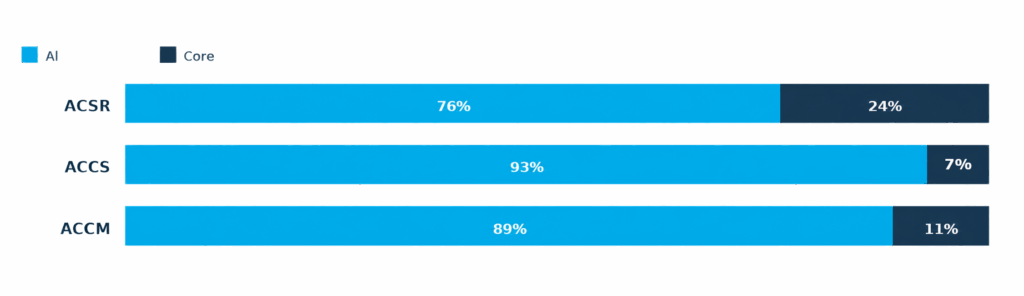
| Aluminum as a percentage of total weight | 76% | 93% | 89% |
| Core relative to total weight | 24% | 7% | 11% |
Bulk composition of the analyzed conductors
This is a crucial detail, as it prevents an overly simplistic interpretation of the comparison. It is not merely a case of “steel versus carbon”: three complete conductor systems are being compared, involving variations in the core as well as the quantity and configuration of the aluminum.
4. ACCM technology and reconductoring
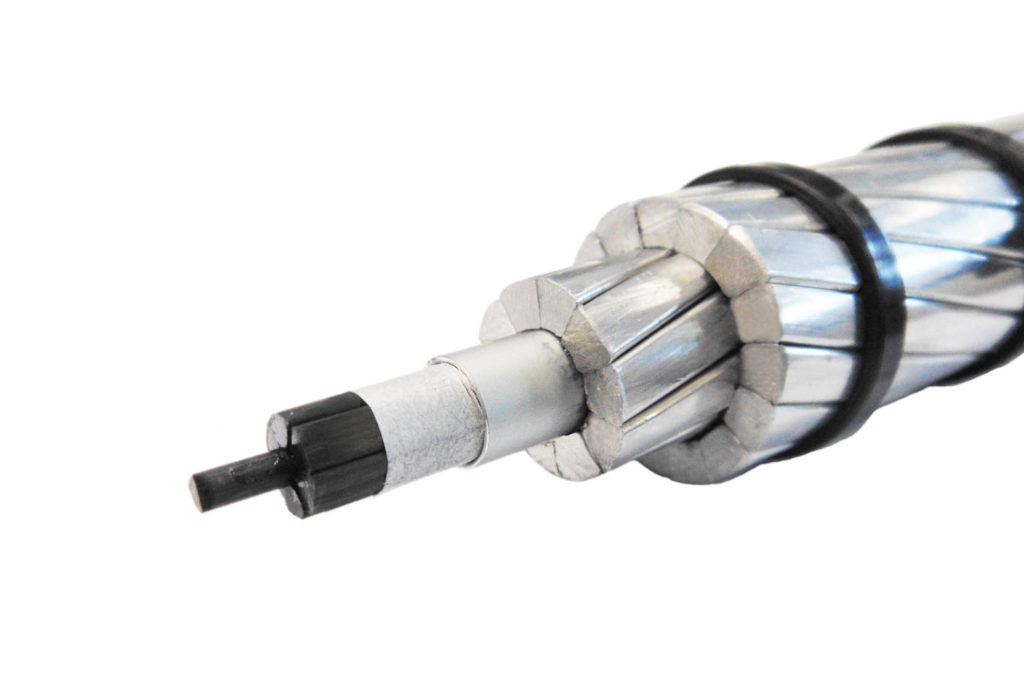
In the case of De Angeli Prodotti’s ACCM, the load-bearing core consists of multiple carbon-fiber-reinforced composite elements stranded together. The core is protected by a tape and an extruded aluminum tube, while layers of aluminum alloy conductive wires are located on the outside.
Carbon fiber makes it possible to rethink the relationship between the mechanical and electrical functions of the conductor. It is precisely this characteristic that makes composite solutions particularly attractive for reconductoring, where the goal is to boost line performance while making maximum use of existing supports and corridors.
However, the paper adds a further layer to the discussion. It is not enough to ask how well an advanced conductor performs; we must understand its overall environmental impact.
4.1 Environmental impact of production
The result during the production phase is clear: replacing the steel core with composite materials leads to an increase in the Global Warming Potential associated with the core, because the production of virgin carbon fiber is highly energy-intensive.
In the ACCM case analyzed, the GWP contribution of the core increases significantly compared to ACSR, whereas the contribution from the aluminum is slightly lower. For ACCS, however, both the core and aluminum contributions increase, a result of the specific architecture of the conductor examined.
The key point
A snapshot limited to the production phase would favor the traditional solution. Life Cycle Assessment becomes significant when it integrates the initial impact with decades of line operation and end-of-life recovery options. In the model, the CFRP core consists of 70% virgin carbon fiber and 30% epoxy resin by mass.
4.2 Electrical losses over 40 years of operation
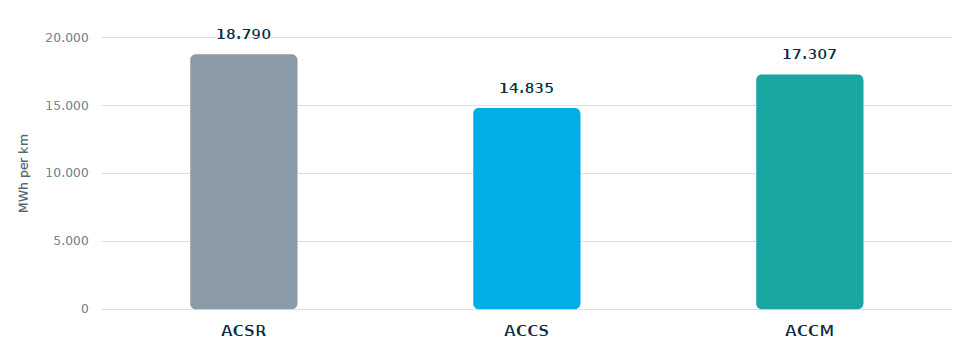
The paper models electrical losses using a comparative current of 840 A and a reference service life of 350,400 hours, equivalent to 40 years.
The result shows that, for the specific configurations analyzed, both composite-core conductors generate lower losses than ACSR.
Electrical losses during 40 years of operation
| Conductor | Current | Resistence | Period | Loss |
|---|---|---|---|---|
| ACSR | 840 A | 0,076 Ω/km | 350.400 h | 18.790,41 MWh |
| ACCS | 840 A | 0,060 Ω/km | 350.400 h | 14.834,53 MWh |
| ACCM | 840 A | 0,070 Ω/km | 350.400 h | 17.306,95 MWh |
This is where the concept of the life cycle takes on its full significance. The initial carbon impact must be weighed against decades of the line’s operation.
5. LCA results for composite conductors
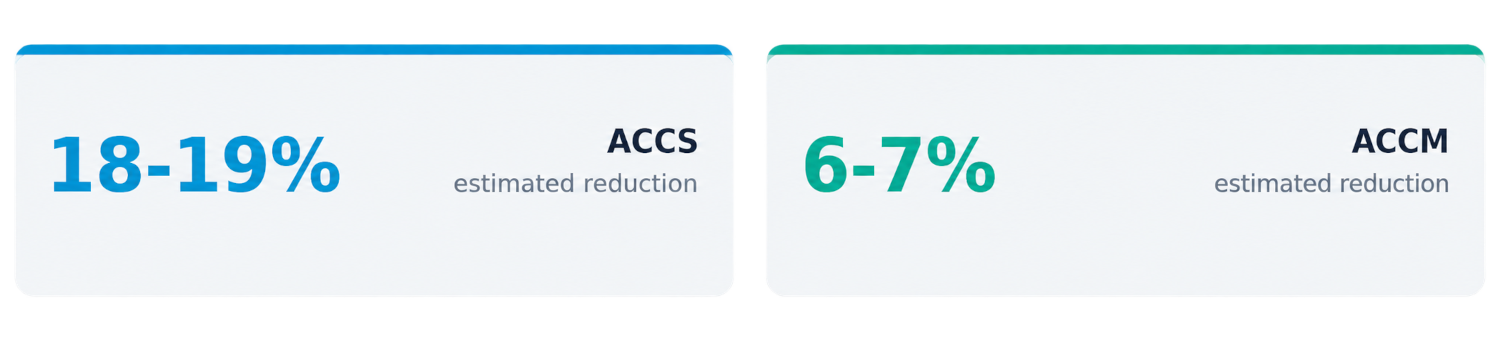
In the case analyzed, when losses occurring during the Reference Service Life are added to the production phase, ACCS records a reduction in climate change impact of approximately 18–19% compared to ACSR, whereas ACCM achieves a reduction of about 6–7%.
Reduction of climate change impact in the case study
How to interpret these numbers
The difference between ACCS and ACCM stems from the specific configuration of the conductors used in the design and their electrical resistance. It does not demonstrate a general superiority of a single-strand core over a multistrand core.
A conductor must be designed based on the line, mechanical and electrical requirements, and project objectives. Life Cycle Assessment does not alter this logic; it simply makes it more comprehensive.
6. End-of-life of carbon-fiber-core conductors
Steel and aluminum already have well-established recovery supply chains. The situation is different for carbon-fiber-reinforced thermoset composite materials.
The use of CFRP in transmission lines is relatively recent, and many of the conductors currently installed remain fully operational. Consequently, there is not yet an extensive body of industrial data regarding their decommissioning after decades of service.
Nevertheless, the research group has conducted tests on the mechanical separation of the aluminum tube from the composite core, using the results as a basis to evaluate potential end-of-life strategies.
6.1 Five CFRP recycling and disposal scenarios
The paper considers five technological scenarios. The following table summarizes their underlying principles and the resulting findings, without reproducing the complete LCI inventories from the publication.
| Scenario | What happens | Value recovery | Indication that emerged |
|---|---|---|---|
| Mechanical recycling | The CFRP is cut, shredded, and reconditioned. | Secondary material; shorter fibers. | Low impact and good material recovery. |
| Solvolysis | A chemical process separates the matrix and the fiber. | Long or medium-long, high-quality fibers. | Among the most promising scenarios: high recovery yield. |
| Pyrolysis | The matrix is thermally degraded, recovering the fiber. | Fiber recovery, with higher energy consumption. | Effective, but more energy-intensive than mechanical methods. |
| Incineration | A portion of the waste undergoes energy recovery treatment. | Energy recovery, not recovery of the fiber’s material value. | Limited benefit compared to recycling. |
| Dump | The material is disposed of as inert waste. | No stoppage time. | Less favorable scenario. |
For inventories, process inputs, assumptions, and complete LCI data, please refer to the official publication.
This is likely the most novel aspect of the research, not because carbon fiber recycling is an unknown topic, but because it is being applied directly to the issue of composite-core conductors for electrical transmission.
6.2 Environmental benefits of carbon fiber recycling
The most interesting finding is that not all recovery processes offer the same environmental value. Carbon fiber embodies a significant amount of energy and resources from its production; consequently, recovering and using it to replace virgin fiber can yield substantial environmental benefits.
In the model studied, mechanical and chemical recycling emerge as some of the most effective alternatives, while solvolysis generally shows a lower impact than pyrolysis in the climate change and toxicity categories. Conversely, incineration, and especially landfilling, prove to be less favorable options.
6.3 Recovery and reuse of carbon fiber
There is a crucial distinction between simply recovering a material and preserving its technological value. A recycled short fiber can be perfectly suitable as reinforcement in a new application, thereby avoiding the use of virgin material; this in itself is a significant achievement.
However, the next, and even more ambitious, step is to recover a fiber with properties sufficient for use in critical structural applications. The paper explores precisely this prospect: under certain conditions, fibers obtained through chemical processes could pave the way for the future reintroduction of recycled carbon fiber into conductor cores.
While technological, regulatory, and qualification hurdles currently prevent this from being considered an established industrial solution, the direction of research is clear.
6.4 Advanced conductors and the circular economy
The research presented in Paris suggests a more mature perspective on sustainability. A material should not be judged solely by the impact involved in producing a single kilogram of it. For infrastructure designed to remain operational for decades, we must consider the function it will perform, the energy savings it will enable, the existing infrastructure it will allow to be reused, and the value that can be recovered at the end of its service life.
From this standpoint, composite core conductors present a paradox that is only apparent: the structural raw material may have a higher initial footprint, but superior performance during the operational phase can offset this over time. Furthermore, if we can effectively recover the carbon fiber at the end of its service life, the overall balance can be improved even further.
The next frontier
The challenge is no longer just to design more efficient conductors, but to build a supply chain capable of supporting them throughout their entire lifecycle.
7. Collaboration between De Angeli Prodotti and Exel Composites
This paper stems from the collaboration between De Angeli Prodotti and Exel Composites, partners leveraging distinct yet complementary expertise across the composite conductor technology value chain.
It is significant that a collaboration originally centered on the development and industrialization of advanced materials now extends to their end-of-life phase. This means addressing a question today that will become a tangible industrial issue years from now, when the conductors currently in service reach the end of their operational life.
This is precisely one of the most interesting aspects of innovation applied to infrastructure: designing something that must function today also means taking responsibility for considering its future.
The research does not regard the issue as resolved. Further studies are needed regarding separation processes, the quality of recovered fibers, other categories of environmental impact, and the industrial maturity of recycling technologies. In parallel, standards, qualification criteria, and regulations must evolve to enable the safe use of secondary materials, even in the most critical applications.
Yet, the journey has begun. And while reconductoring with advanced conductors is already a tool for making grids more capable and efficient, the next frontier could be to make their very core increasingly circular.
8. Conclusions
The sustainability of an electrical conductor cannot be assessed based on a single material or production stage alone; instead, the infrastructure’s entire lifecycle must be considered. The study presented at the CIGRÉ Paris Session 2026 highlights how, under the analyzed conditions, advanced conductors with carbon-fiber cores can offset their higher initial environmental impact through reduced electrical losses over decades of operation. At the same time, the research opens up new perspectives on composite material recovery, demonstrating the importance of developing recycling processes capable of preserving the carbon fiber’s technological value.
The collaboration between De Angeli Prodotti and Exel Composites represents a concrete step toward this vision, while acknowledging that many technological and industrial challenges remain to be addressed. The true challenge for future electrical grids will therefore be to combine performance, energy efficiency, and circularity by designing conductors today that can contribute to the energy transition for decades and retain their value even beyond their operational lifespan.
Bibliography
- Hassinen A., Dorigatti G., Kloster H., Duman D., Sustainable End-of-life for Advanced Composite Core Conductors, CIGRÉ Paris Session 2026, Study Committee B2 – Overhead Lines, Ref. B2_11363_2026.